Must everyone pick a side?
Restored from Instagram stories ·
this is a brilliant question as well where people seek answers but are usually shut down by popular quotes which mark political discourse today.
an example would be from desmond tutu
“if you’re neutral in situations of injustice, you’ve chosen the side of the oppressor”
we’re going to look at this in multiple layers. how did this come, why and how should you stand.
if you’d done my homework on critical thinking and epistemology - this is gonna help you.
in its core, the claim “you can’t be neutral” assumes that:
- every political issue has a binary moral valence (right vs wrong, oppressor vs oppressed).
- silence or neutrality equals tacit support for the dominant power.
epistemologically, this is a foundationalist moral stance - it presumes that:
- there is objective moral knowledge about which side is just.
- people ought to align with that moral knowledge.
- non alignment is equal to complicity.
but epistemology also allows us to critique this:
- knowledge is often situated and constructed through narratives, media, institutions, and power relations.
- what one group sees as “oppressor vs oppressed,” another may frame as “conflict of interests” or “multiple intersecting claims.”
- there is epistemic underdetermination - the evidence about justice in complex social issues can be incomplete, contested, or perspectival.
so one of the early conclusions that we can arrive from this is thatcentrism isn’t inherently immoral. it can also be:
1. a recognition of epistemic complexity (issues are not reducible to one moral binary),
2. a provisional stance (waiting to commit until more evidence or clarity),
3. a meta-position (critiquing the frame itself rather than picking a side).
saying neutrality equals oppression presumes a settled moral truth where there may be contestation or complexity.
that itself is a political stance and not a neutral fact.
but is this all about what centrism could be?
no. there is more to this.
paulo freire, herbert marcuse, and later critical theorists often argue:
“neutrality in situations of oppression favors the oppressor.”
this argument arises from:
1. structural power is asymmetrical - the oppressed don’t have equal capacity to shape outcomes.
2. neutrality therefore de facto stabilizes the existing power structure.
however, critical theory also recognizes ideology - the way dominant narratives shape our perception of what counts as “oppression” or “justice.” - the same was used in color revolution and everywhere where another powerful country wanted to overthrow power in another country.
this means:
accusations of “centrism = support for oppression” can themselves be ideological tools to police discourse.
power can operate within activist spaces too - not just on one side. (this is why i call most activists as useful idiots since they can barely identify this)
a nuanced critical-theory response would be:
yes, neutrality can functionally favor existing power but…
1. it can also be an act of resistance against false binaries and manipulative moral frames,
2. especially in plural, complex conflicts where the moral landscape isn’t as clear-cut as liberation struggles (e.g., colonialism) once were.
critical theory warns us not only about oppressors but also about the hegemonic power of narratives. forcing everyone to ‘pick a side’ can reproduce new hierarchies and foreclose critical thought.
but be aware of what they ask in critical thought too. because most conspiracy theory starts with, i am just asking questions. am i not allowed to ask questions? they ask questions to cherry pick narratives to whitewash crimes.
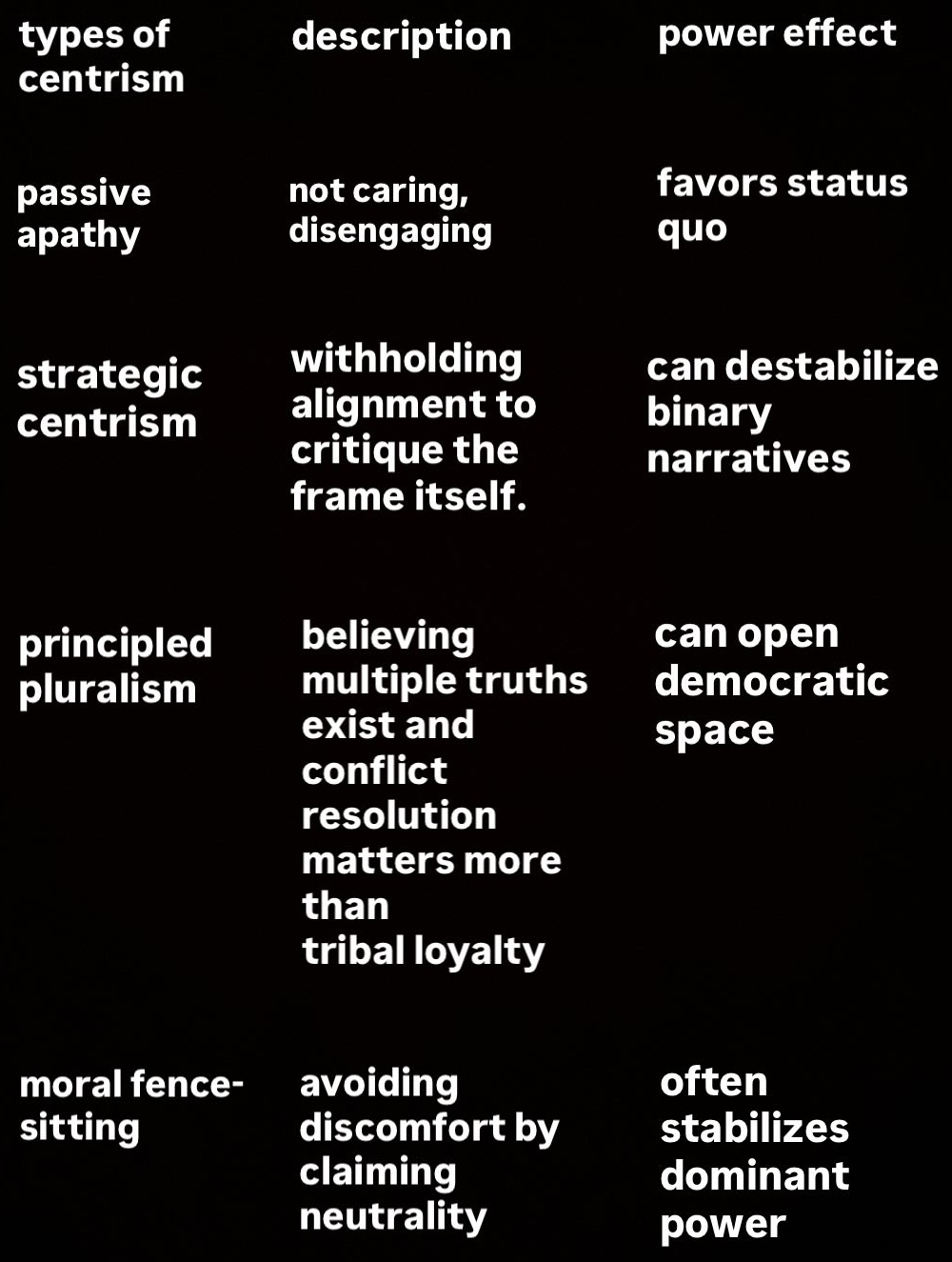
in the matrix, if you could see that - you should hate 1 and 4. they add nothing to discourse but hey - people can do that. you don’t know why people are subscribing to the fourth.
might be their job or anything. people can be selfish since you can’t feed them if they lose their means to feed. it’s okay. you should be rational enough to understand this.
2 and 3 is good. but 3 is amazing.
very few people can understand critical thinking and epistemologically ask questions to reach 3.
there are three different ways you should look into things.
a. epistemic challenge
“you are assuming the moral landscape is binary and settled. but that’s often a product of power narratives. centrism can be a refusal to collapse complexity into binaries.”
b. critical theory challenge
“yes, neutrality can reinforce power but so can moral absolutism that forces alignment. critical theory critiques domination everywhere even in activist discourse.”
c. moral agency challenge
“moral responsibility isn’t exhausted by choosing sides. it can include questioning narratives, facilitating discourse, and holding both sides accountable.”
philosophers like hannah arendt and chantal mouffe would remind us:
1. political neutrality can also be a way to resist ideological capture
2. and preserve the agonistic space (the space of disagreement necessary for democracy)
—-
now you know what to like and what to hate in centrism. don’t let blanket quotes win against you.