Raising curious children
Restored from Instagram stories ·
one of the things that most people forget during their normal life is the life of juniors of their own species except when they want to complain about them or when they’re about to become/are parents.
but the fundamental thought towards children should be - around the fact that these juniors are the new members of our society who’ll take the civilization to the next step
and we are duty bound not just as parents but as a member of the society in ensuring that we’ve created environments in which they grow to be productive members of the society and are the next responsible adults to whom we hand over the leadership of the society after our time passes.
earlier, as we designed human social living - advanced civilizations encouraged and built common schooling system for all the juniors of the society so they can be given uniform education to be members of a functioning human society to work.
then - parents would just imitate their peers and will outsource the important decision of educating the juniors to bureaucracies/local government.
but then, a new movement started.
a new movement where parents want the best for their kids. even though this movement started as a non-peer rebellious movement, this is no longer the same.
this parental obsession in ‘creating’ intelligent kids who should surpass all of their peers isn’t something that’s weird or wrong.
every junior who grew upto be exceptional tend to have spent their early formative years surrounded by adults who wanted them obsessively to be the best and gave them the best what they could offer with their limited/unlimited resource to the best of their intellectual capabilities.
you’ll find this in aristocratic families to poor farm parents who did the same.
the old movement was an anti peer rebellious movement while the new movement started by newer parents who want to obsessively raise intelligent better kids in the last two decades - thanks to information technology software parents who have contributed to economy a lot, isn’t inherently rebellious but actually peer led.
do you know who exactly lives in the opposite spectrum of the same rebellious education trend where they believe modern education teaches stuff against their culture, debunks their long held beliefs in the name of science and so on?
culture zombies who hate modern education.
it’s the perfect iq bell curve more commonly known as the midwit meme.
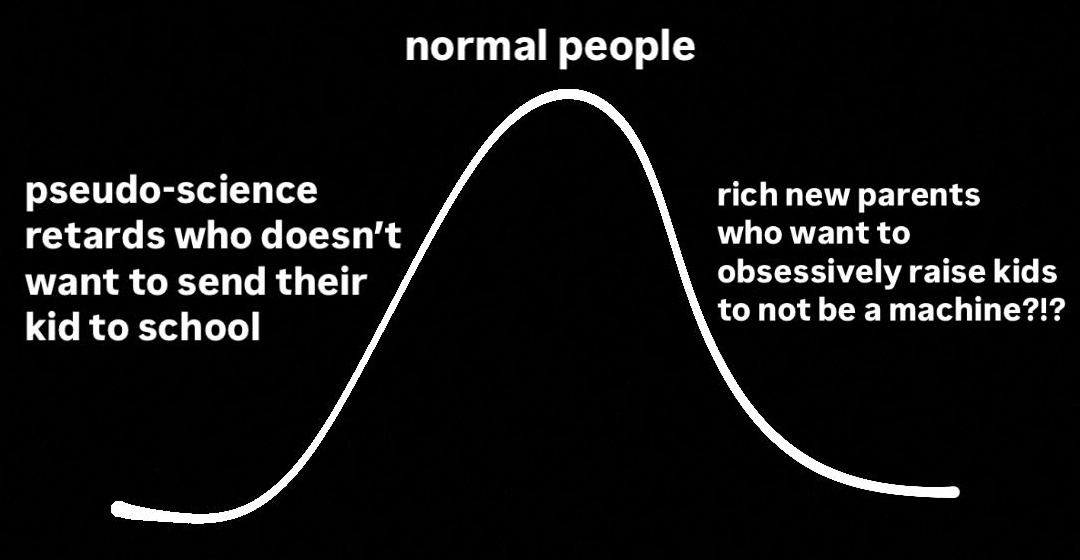
who do new rich parents think that something is wrong with the current education system?
they believe that the education system excels in creating job seekers or people who are machines that can be a part of the system where they consistently work for the top 1% of the society to make them rich.
this is the same exact dialogue told by the andrew tates of the world who sell grifting courses telling you that the real world doesn’t teach you those things and their courses online by real world teachers teach you to own your business or be your own boss.
literally every grifter uses the same exact words. why? because it’s relatable.
they already talk to you. they whisper into your ears something that you secretly or have already started to believe.
maybe you’re disgusted becausei told you the names of the grifters. it won’t feel like one of i introduce a fancier word like montessori or any of the japanese words which are fancy.
right?
let’s get back to the basics.
why and when - did these parents find this strong obsession of doing crazy things where they think that they should take back the job of a society from educating their kid and they should do it on their own?
let’s sample kids. not just any kid. exceptional kids whose names are known and how their parenting happened.
philosophers like descartes, russel, composers like bach, mathematicians and writers.
if you take their biographies and read them - you’ll find something very common.
some of them shared ‘hatred in a complicated way’ for their parents. this is an interesting line which i will refer to and speak broadly later.
but all of their parents either poor/rich obsessively tried to create the best environment for their kids to grow in a very intelligent way.
let’s go through them one by one.
//credits to henrikkarlson’s curation.
either their parents forced them into this or they paved the way for themselves to make these tough choices to become intelligent.
1. blaise pascal - homeschooled. his father etienne was passionate about math. he didn’t want to share that with pascal since he didn’t want math to distract him from less intrinsically rewarding pursuits like literature.
but when it was discovered that pascal taught himself math and re-devices several of euclid’s proofs, the family relocated him to paris so both father and son can participate in the mathematical salons of mersenne.
2. famous writer virginia woolf never attended school. her dad leslie and tutors educated virginia and her sister.
let’s see what her dad did.
leslie invited henry james, thomas hardy and alfred lord tennyson to dine and converse with his children.
leslie described his circle where his kids grew up as “most of the literary people of mark, clever young writers and barristers,…
they used to meet on wednesday and sunday evenings over “dinner” - to discuss the universe and reform movement. when they went to hebrides in the summers, leslie brought along painters and philophers, who’d hang out and work in their summer house while the children played.
3. michel de montaigne (famous philosopher)’s dad employed only servants who were fluent in latin, curating a classical culture so he’d learn latin as his mother tongue. why? most literary/dogma materials were in latin and he created an environment for his kid to learn the language so he’ll read and debate and grow intellectually .
4. hope you all know about john von neumann - the hungarian physicist who at one time managed the development of the hydrogen bomb and the first digital computer and invented game theory as a past time at night?
let’s look at the notes of john’s , the younger brother nicholas.
- - “from the business visitors at a relatively formal dinners, and from fathers approach to them in the context of the activities of his banking house, we got introduced to the secrets of making business contacts and of management with executive powers and fathers banking house. this was always discussed just as all school subjects and analyzed in terms of father‘s management of his activities through the means of delegating powers to his associates and staff.” - -
basically john was included in the discussions of the management of his father’s bank before reaching school age.
5. bertrand russel at 5 years old refused to believe the earth is round. i recommend reading his later year thoughts and works - but let’s get to the point. his grandpa’s didn’t laugh him off. they too it seriously and called the vicar of their parish to reason bertrand out of his misconception.
6. do you remember that i said this is not just about rich people, but also about poor parents who did the same thing? they raised exceptional kids.
let’s take the example of ramanujan. he famously sent letters to the large number of english mathematicians until one of them - g.h. hardy realize that the strange little weird kid who was writing letter from india isn’t a wacko but a raw genius. brought him over to cambridge.
7. faraday was piss-poor. 1800’s london. spent less than a year in school, became a book binder’s apprentice - benjamin franklin vibes?
the book binder is george riebau, an intellectual role model and he gave access to those books to faraday. he stumbled across isaac watt’s self help book (the only self help book i wouldn’t diss) - start attending scientific lectures where he took copious notes.
he also turned Humphry Davy’s lecture series into a book, bound it and gave it to davy as a gift. davy impressed- accepted faraday as an apprentice in his lab and the rest you know is history.
let’s get back to the subject. although i would diss present day europe as europoor, i wouldn’t dare the say the same of europe a couple hundred years back when they actually mass manufactured range of remarkably gifted, multidisciplinary scientists and scholars whom I would call as exceptional polymaths.
the world didn’t see such intelligent geniuses from one area - until the end of world war 2 when america did it (and it continues till this day)
mozart, alan turing, maxwell the scottish mathematician - i can keep going on and on.
what was the one freaking thing that was common across all of this high exceptional kids?
i believe one of the most important things that you know we should understand is the fact that you’re part of a social structure which science were term as a social animal, and kids, obsessively - analyze values, ideas, skill, and desires from the people who surround them.
most of these examples whom you have seen me talk about exceptional kids - were integrated with exceptional adults early in their life and not with their social peers. if they spent time with their social same-age peers it’s more often that not with similarly intelligent exceptional kids (a very rare occurrence).
most of the parenting that revolved around this highly exceptional kids had one theme in common - they all had high expectations of the children where they assumed that they had the capacity to understand complex topics, and therefore invited these children into serious conversations and meaningful work, believing that these kids are capable of growing competent rapidly.
do you remember where i previously lectured in a long essay on not using easy words with kids or replace actual real life words with baby words and actually use those complicated words with tough spelling and punctuation because kid’s brains are plastic and they can absorb a mass amount of information since they want to learn the language of the adults quickly to fit into the social structure?
remember it now.
The second common theme across all these children were - they had access to books whether they were rich or poor.
if you must read the words of russel (whose works i’ve recommended) the most famous comment would be - - that the development of such gifted individuals required a childhood period in which there was a little or no pressure for conformity, a time in which the child could develop and pursue his/her own interests no matter how unusual or bizarre.
it was a rebellious take on the education system that existed before. absolutely zero peer pressure. modern rich parents who want to emulate home schooling do it in the most damaging way possible by trying to tutor what they know, prescribe them to online education whose quality they can’t assure of, the most pretentious coaching classes where they get the kids, 100 other extra curricular activities to ensure that their kids are the best
—> it’s almost a heavy peer pressure from parents to obsessively raise intelligent kids by placing them on a high pressure race to satisfy their own egos.
they hate their kids to be bored. they don’t want the kids to be bored. they don’t want to leave their kids alone.
it’s almost as if modern parents micromanage their kids life on a schedule on what they need to do.
these kids have also got used to this life. it’s almost dangerous. they’ll come to you and say - mama, papa, i am bored.
i am making a very careful argument. kids need to be bored. they need to be left alone to do what they want however crazy it is - amongst the eyes and company of really remarkable intelligent people who’ll encourage them and have patience to teach and discuss with them as if they’re a fellow adult.
i’ll tell you something deep about boredom. this immersion in boredom is another big big important key universal team in the biographies of exceptional kids.
they had books and their environment to turn to when they were bored. when they were bored, their creative juices flowed. when they were bored, they thought. they were suddenly not being asked to follow instructions or being instructed what to do, no schedules to follow. just them and their brain thinking around what to do.
being bored is good for kids.
it’s almost as if every exceptional kid who contributed to their field of study which eventually gave them the fame because of which we know them - almost came to them like a wild hallucination around which they got obsessed.
every single thing had boredom behind that out of which they followed this and got obsessed into learning more.
their new obsession replaced their existing boredom.
are we calling them turbo-autists now?
pascal who self taught math, alan turing who also self taught math, maxwell who unified electricity and magnetism - absolute boredom.
i do remember when austrian physicist boltzmann proclaimed maxwell’s work as “was it a god who wrote those signs?”
maxwell’s biography is a must read. he’s a wild kid who grew fascinated by geometry and rediscovered regular polyhedra. when his parents tried hiring a teacher, he hit his tutor, ran out to a lake and refused to come back until they fired the tutor.
his first ten years of his life? reading novels and books, doing mischief and regular kid life.
all of these exceptional kids, had little access to entertainment. they were consistently often bored - until they figured out a way to keep them occupied.
how did their parents facilitate that?
- books
- company of intelligent people and treating them as adults taking their conversations seriously instead of brushing them away
most of the intellectual obsession that these exceptional kids grew into their life’s work often grew out of this boredom.
my most biggest pain point is when i see parents who want to give the best to their children pull the kids out of regular school and put them in homeschooling and montessori and end up raising them in the worst way possible where they wouldn’t fit into the society that they live in.
the early ones i have examples of, raised their kids to fit into the society and contribute to the same. they were rebels.
the modern ones think they’re rebels but are wannabes who are hurting the kids more than they think. they’re thinking they’re doing good, but in a heavy wrong way.
i am not against how you chose to raise kids. homeschool or not? not my problem. but raise them right.
so what about regular schooling?
regular schooling is an industry where it merely gives what the society wants. peer pressured parents are obsessive about intelligent kids so they pack them with 100x stuff that the kid doesn’t even need and keep them occupied.
early working parents wanted to keep them occupied so tuitions and heavy homeworks to not get them bored became a norm. want extra free time? drop your kid to that coaching class, this coaching class etc.,
some saw that it’s too pressuring so they ended up home schooling them but it’s a micro managing nightmare where they lost their own peace and as well as are intellectually stunting their kids into brain dead zombies who’ll consume peak brainrot in cocomelon when they are kids and reels when they become older.
they are thinking that they’re raising their kids right because their kid can wire a circuit and are learning how to code and are rich in worldly knowledge - but end up growing as dysfunctional adults who need therapy and can’t find a mate , can’t date, have no relationships, have huge trust issues, traumas which are invented daily and live a regular imposter syndrome where internet is their daily life.
genz is an early example of kids raised by parents who tried their best to raise the best kids.
so what is right?
being normal is right. finding a regular school which allows your kids to be bored, keeps academics light, has the best teachers who allow the kids to be curious and grow is good.
cbse, icse, ise, state? doesn’t matter. the two things i wrote down matters more.
if your school isn’t doing that, you as a society should dictate that. put kids into schools which allow this to happen. or work on creating schools which allow this to happen.
right now for all that matters,
a regular school does less damage than what any other forms of education can do.
i have more thoughts on this and where exactly we are going wrong, but before i break to my easter lunch, i have left you my preliminary thoughts.
we’ll discuss more and i will write more as i structure my thoughts.
All rights reserved. Copyright © 2026 Jason Samuel